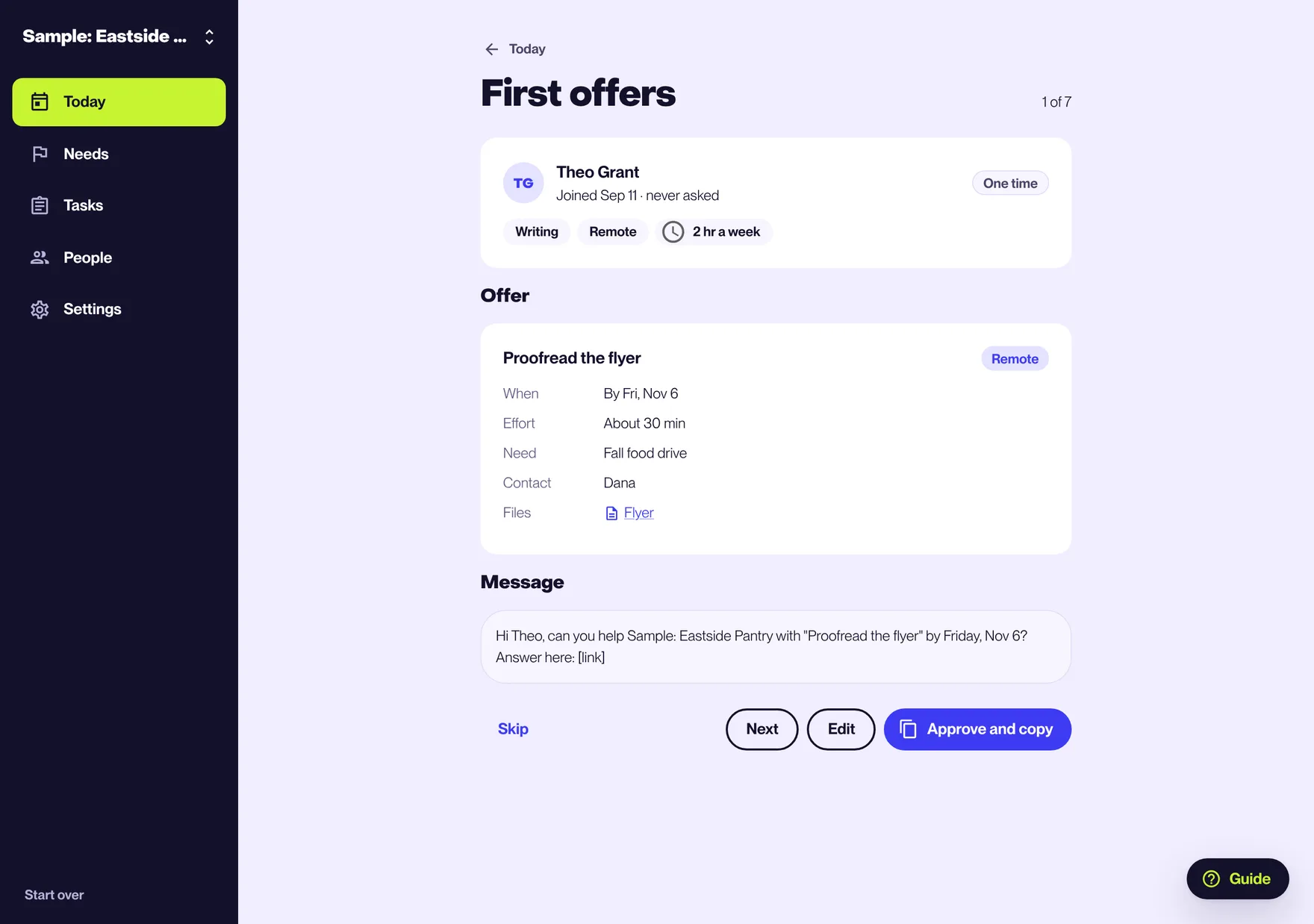
Theo Grant joined Eastside Pantry on September 11, 2026. Seven weeks later, nobody had asked him to do anything. On Monday, November 2, 2026, the pantry's coordinator opens Volley to a list that starts with "7 first offers ready." For Theo, Volley suggests proofreading a flyer, a 30-minute remote task due Friday, because writing is one of his skills. After approving the offer, the coordinator pastes Volley's message into a text to Theo.
Eastside Pantry is one of six sample organizations in the Volley demo. Volunteer activation is the step after an organization approves a volunteer, when that person gets their first piece of real work. Volley is the tool Vloora built for that step.
Most volunteers wait after they sign up
Organizations often recruit more volunteers than they can put to work. When England's National Health Service asked for 250,000 volunteer responders in March 2020, 750,000 people signed up. By May 3, 2020, the program had logged 100,000 tasks for the 600,000 who passed their checks. In a survey of 11,107 responders that the program published in December 2022, nine percent said they had never been offered work within their travel distance.
Some people never get past the application. In a 2015 Do-it Trust survey of 4,234 people, 20 percent said nobody replied the one time they applied to volunteer.
Placing each new volunteer takes a coordinator's time. Someone has to work out what each new person could do, write the task, find a time, and send the ask. Most of that work happens in email lists, spreadsheets, and forms. Three organizations in Portland, Oregon, show the pattern:
- A homeless services organization can't place a physician who wants to help, because it's open only during her working hours.
- A community radio station keeps its volunteers across several email lists, with no single list of who is active.
- At an arts organization, volunteers log their hours through a Google form that's hard to find.
Each new person gets a suggested first task
Volley's Today page lists what needs a decision under the day's date. The pantry's list starts with its seven first offers, for approved people still waiting on a first ask.
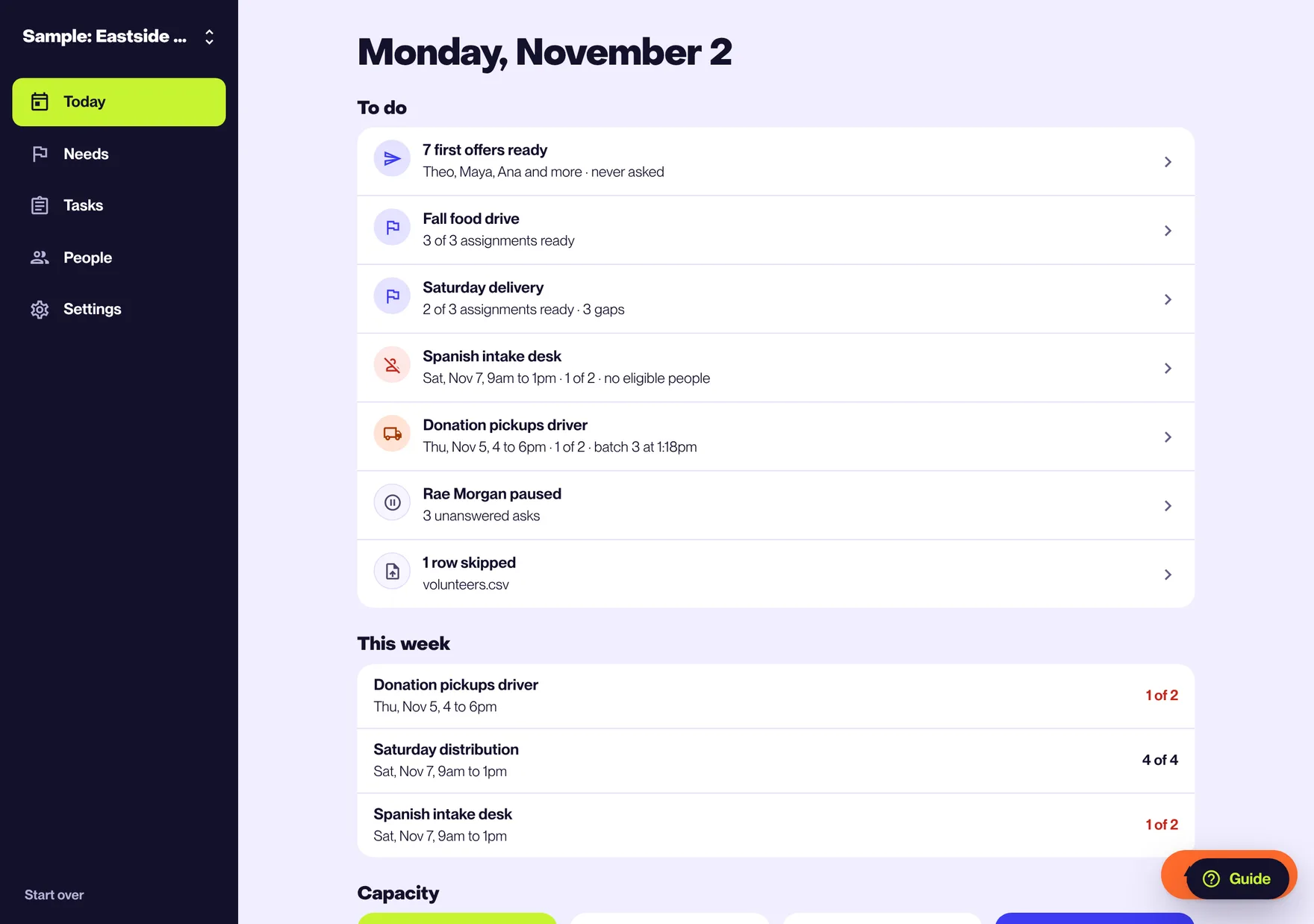
For each of those people, Volley picks the open work that fits best. Remote work ranks first, work that uses one of the person's skills ranks next, and shorter work wins a tie. The coordinator approves each suggestion, edits it, or skips it.
Volley asks the people who have waited longest
When a task needs people, Volley lists everyone who fits, in order of how long each person has gone without an ask. It also lists who it can't ask, with the reason: a missing requirement, the weekly ask limit, a clash with another spot, a pause, or no consent to contact.
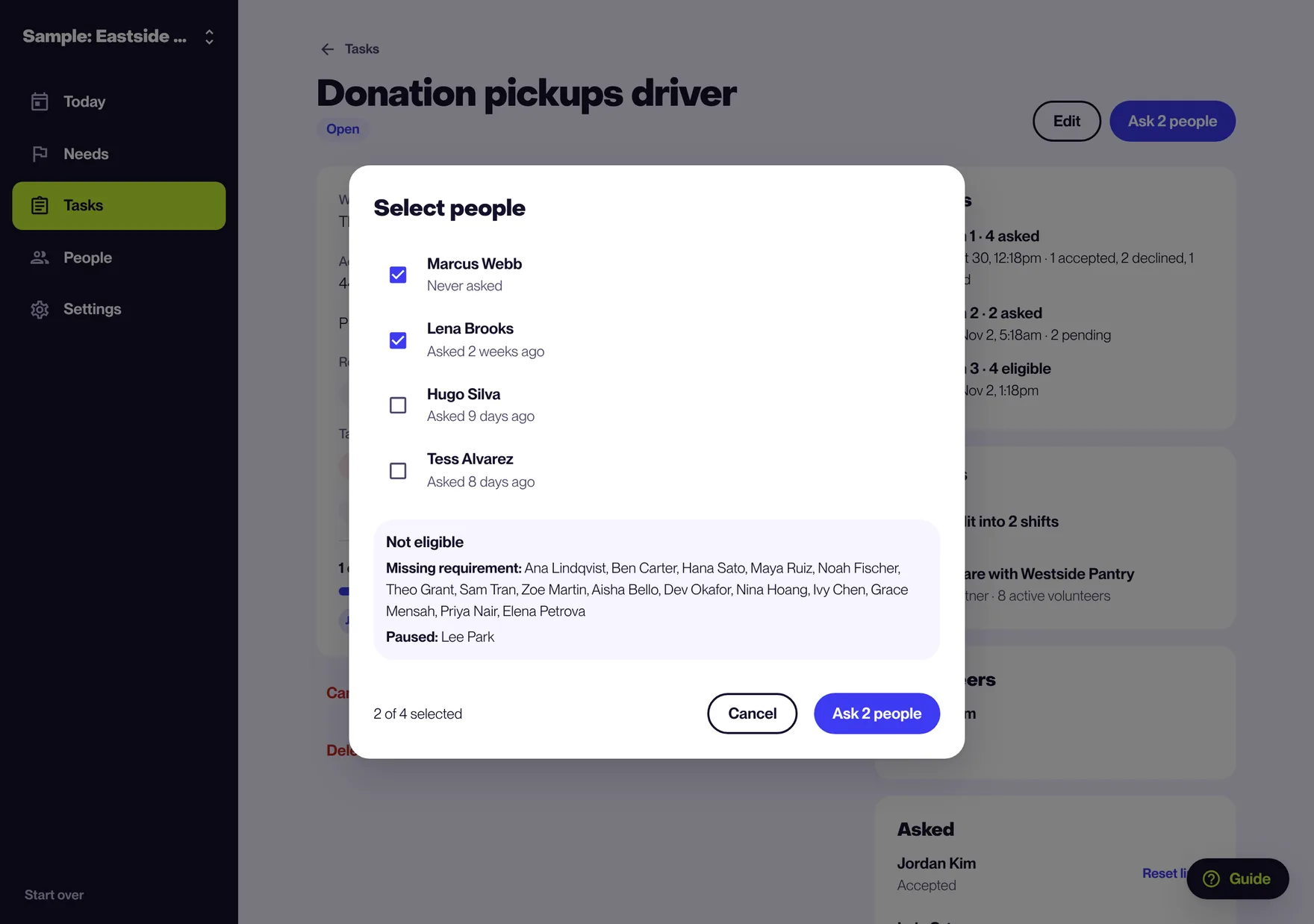
Asks go out a few at a time. By default, Volley asks twice as many people as there are open spots. When a batch runs out of time with spots still open, Today tells the coordinator to ask the next group.
A volunteer answers from a link on their phone
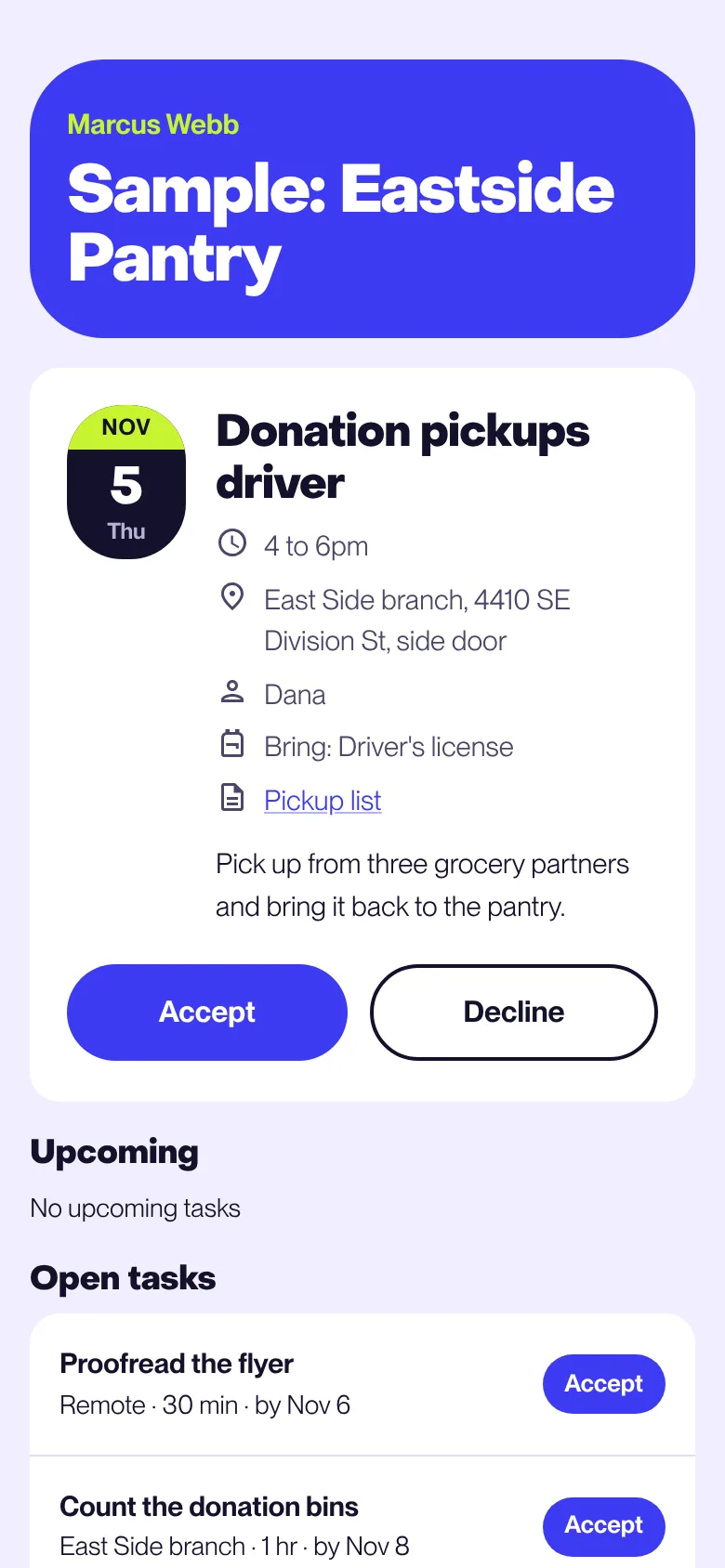
Each person Volley asks gets a private link. The coordinator pastes it into the email, text, or group chat the organization already uses.
The page shows the task, the time, the place, who to find, and what to bring. Below that, the volunteer sees open work they fit, which they can accept directly. Volunteers never see each other's names.
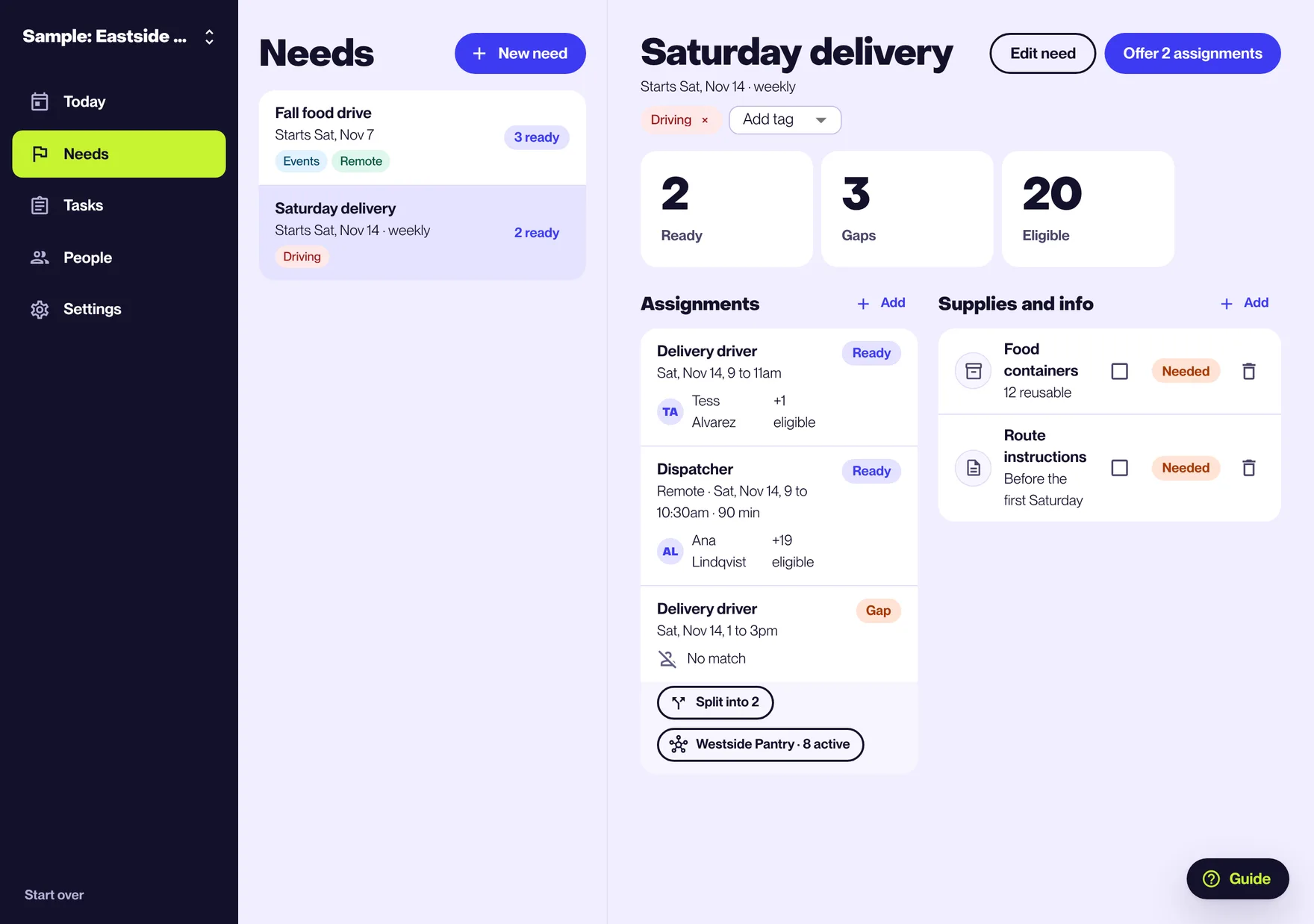
Needs show the gaps before an event
A need is something the pantry wants to run, such as its weekly Saturday delivery. It groups the assignments the event can't start without. Each assignment shows how many people fit it. For the delivery shift that nobody fits, Volley suggests sharing it with Westside Pantry, a partner with eight active volunteers.
The rules Volley follows
- Volley starts after an organization approves a volunteer. Screening happens before a person reaches Volley.
- The schedule is the record. When a task's time passes, Volley counts each spot as attended unless the coordinator marks a no-show. Nobody logs hours.
- Each ask also checks whether the person is still available.
- By default, each person gets at most two asks a week.
- After three unanswered asks, Volley pauses that person until they answer one.
- Volunteers can pause their own asks until a date they choose.
- A coordinator approves every first offer before it goes out.
- Volley proposes tags from each person's skills. The coordinator can change any tag.
Try the demo
Open the Volley demo. It runs in your browser with six sample organizations: a food pantry, a professional association, a community radio station, a youth nonprofit, a disaster response company, and an events staffing company. A guide with 23 stops explains each feature. Anything you change stays in your copy. The Volley page describes the product.
Test results
All 34 of Volley's tests pass. They check that:
- Only people who meet a task's requirements get asked, longest wait first
- The weekly ask limit holds on the server
- When two people accept the last spot at once, exactly one gets it
- A task counts as done when its time passes, with nobody confirming
- An old private link stops working once a new one is made
- One organization can never reach another's records