A caseworker in Absaroka entered $1,075 per pay period for a household member who works at Two Forks Diner. The four verified pay stubs in the case file each show $925. Because the entry was higher, the Heil household was issued $232 a month in food benefits when the state's rules call for $348.
Vloora built Project Six to catch that difference before the payment goes out. The software checks every preliminary decision in a caseload for the Supplemental Nutrition Assistance Program (SNAP), which helps people buy groceries. To test it, we built Absaroka, a state with generated households. The screens below come from a run of 40 Absaroka cases.
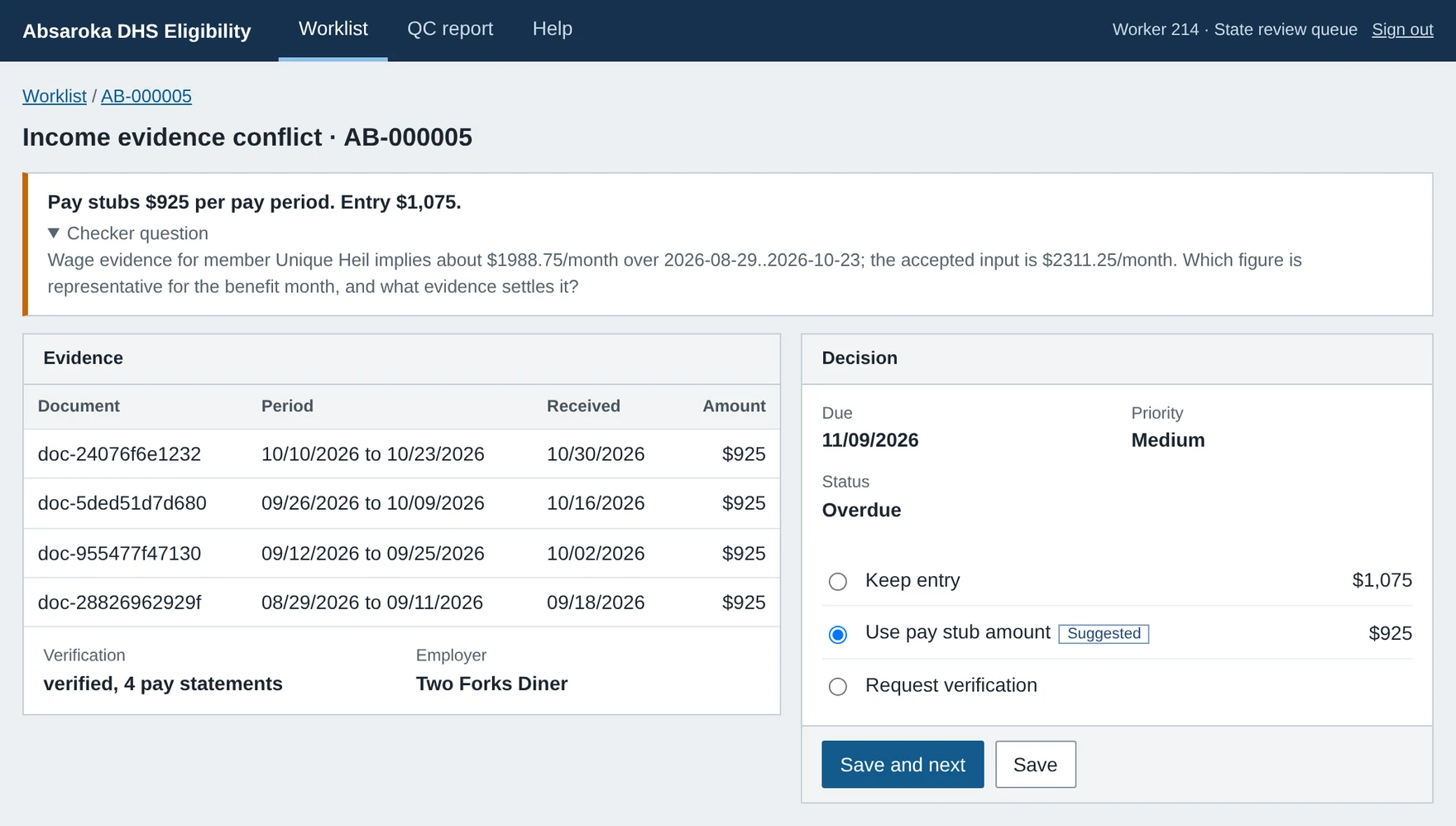
Project Six's checker reproduces each benefit calculation from the records in the case. For case AB-000005, it converted the $925 pay stubs to $1,988.75 a month, where the case had used $2,311.25. Each figure uses the federal multiplier of 2.15 for a paycheck that arrives every two weeks.
The checker turns the difference into a question for the worker: Which figure represents the benefit month? The four pay stubs sit beside the question, each with its pay period, its amount, and the date the state received it.
Every finding becomes a task in the worklist, which gives it a priority, a due date, and a status. The 28 flagged cases in this run produced 44 tasks.
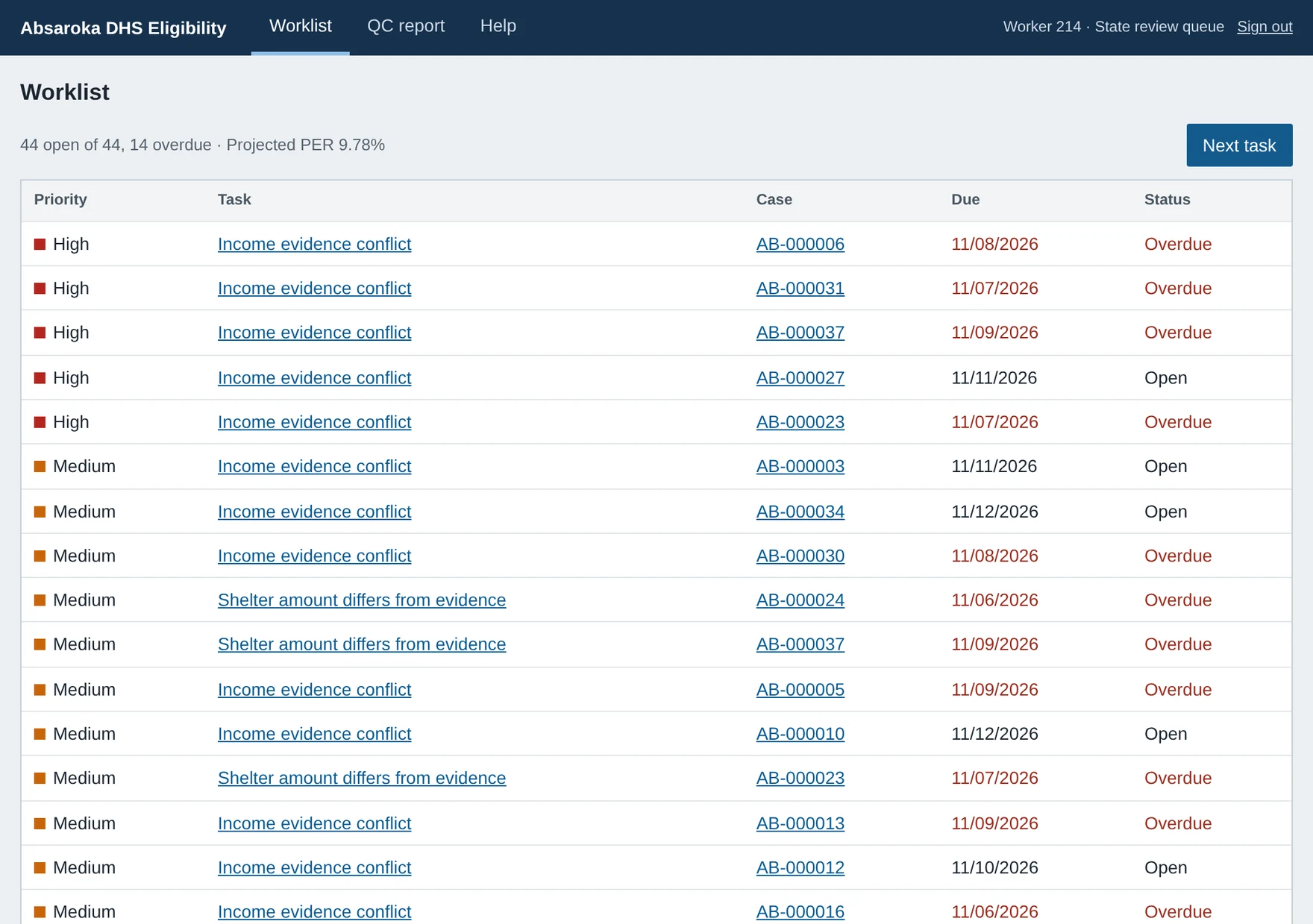
A worker who opens the task has three choices: keep the entry, use the pay stub amount, or request verification. Because all four verified stubs agree, the checker marks the pay stub amount "Suggested," which is the choice the worker on this case made.
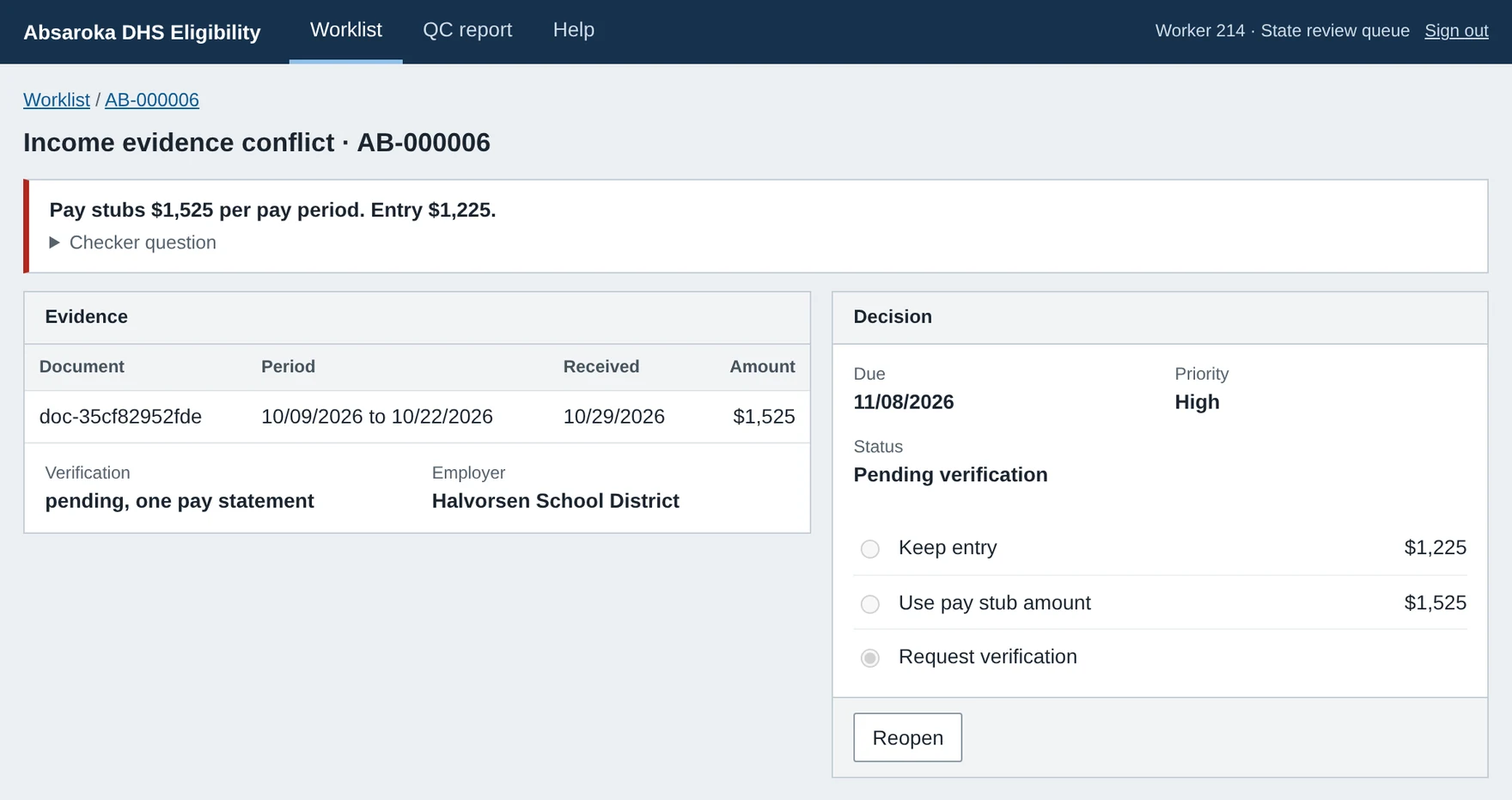
When the file can't answer the question, the checker suggests nothing. Case AB-000006 holds one pay stub for $1,525 against an entry of $1,225, with verification pending. After the worker requests verification, the case waits at "Pending verification" with its $477 payment unchanged.
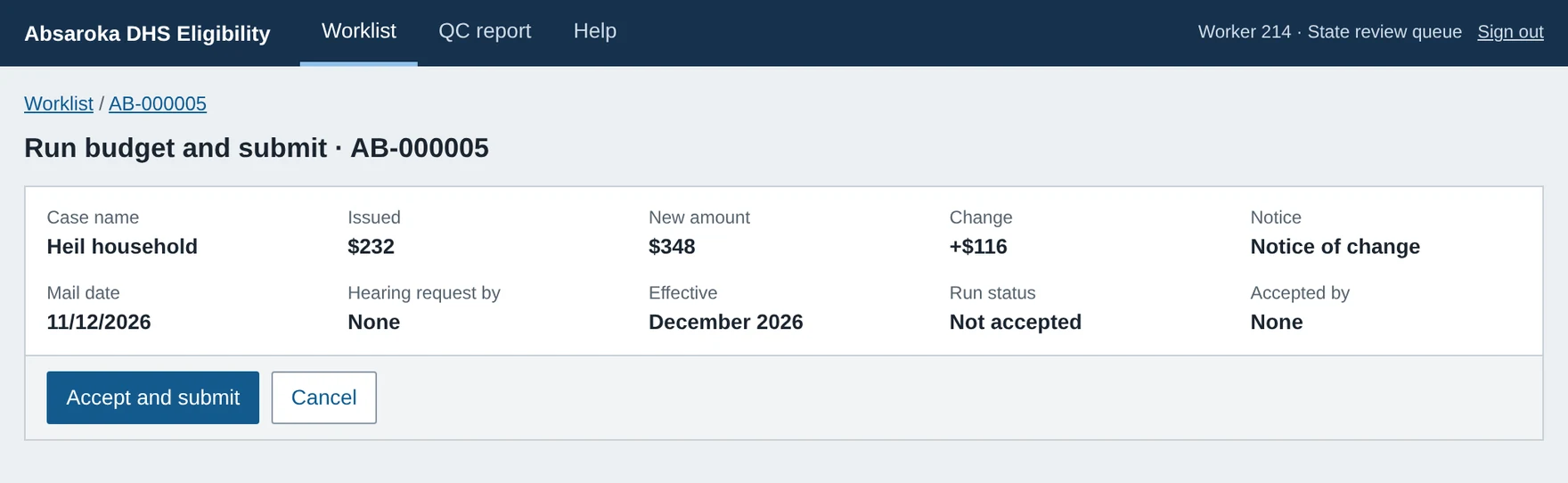
Only a worker's submission changes a payment. Once the worker has answered every finding on a case, a task to run the budget appears. For AB-000005, the budget shows $232 issued, a new amount of $348, and a change of +$116. The payment changes when the worker selects Accept and submit. A notice of change goes in the mail on November 12, 2026, with the new amount effective in December.
The Heil household's $116 underpayment counts toward a SNAP payment error rate, which is the share of benefit dollars paid in the wrong amount. The U.S. Department of Agriculture (USDA) reported a national rate of 10.62 percent for fiscal year 2025. Beginning in fiscal year 2028, the federal cost-sharing schedule generally charges a state part of its benefit costs once its official rate reaches six percent.
Project Six's report scores the generated caseload the same way, with the fiscal year 2027 tolerance of $59. The run started at 9.78 percent. With AB-000005 submitted, the projected rate is 8.96 percent.
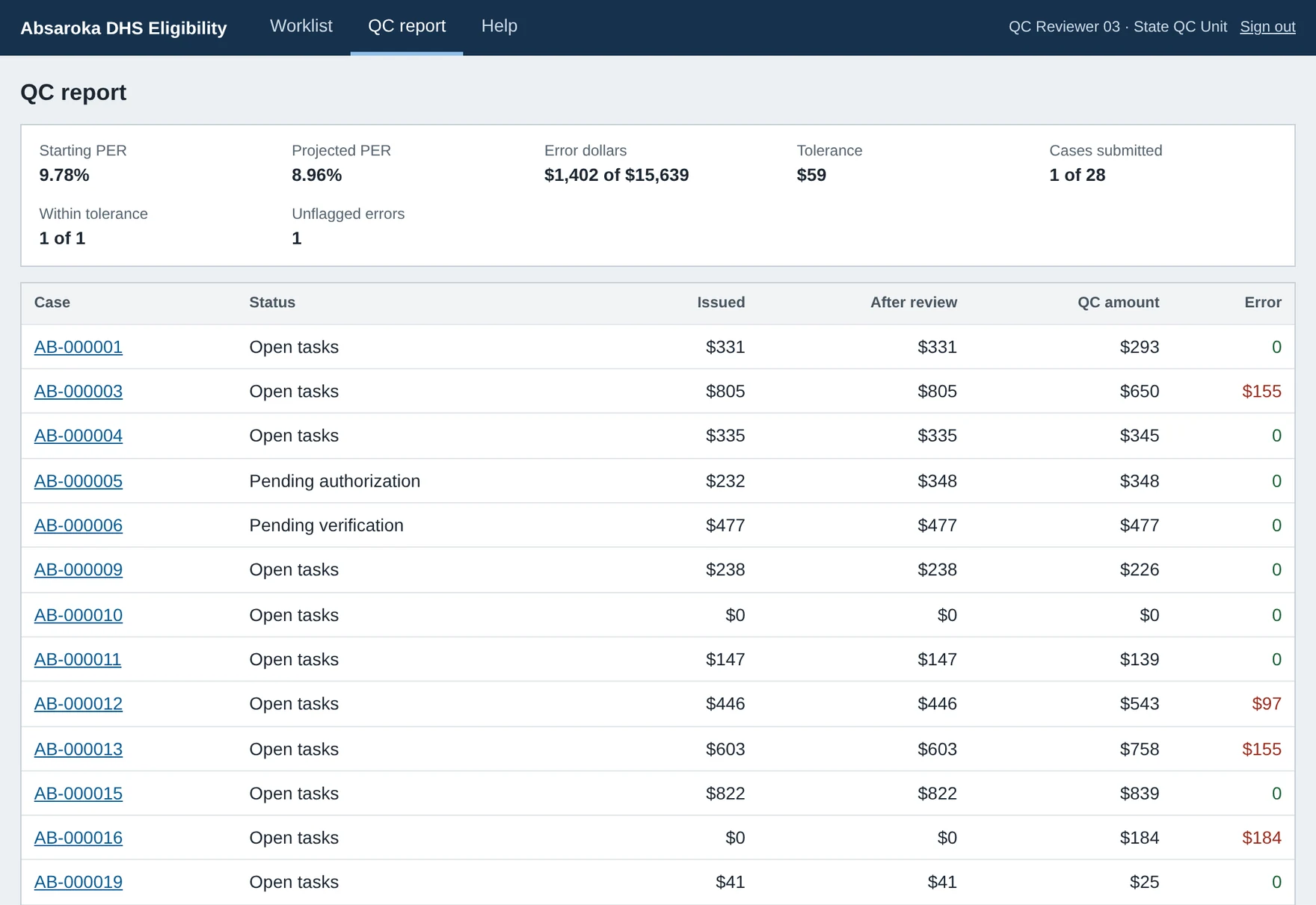
These rates describe generated cases. A state's official rate comes from federal quality control reviews, which can interview a household for facts Project Six never receives.
We also ran 10,000 cases without the browser, on the same rules, with a scripted reviewer standing in for the caseworker. The reviewer accepts a correction only when every verified record in the state's file agrees, which leaves every other finding open.
Table: Simulated results for 10,000 generated cases, run November 12, 2026
| Measure | Result |
|---|---|
| Payment error rate before review | 10.00% |
| Payment error rate after review | 5.40% |
| Error dollars before review | $370,504 of $3,705,498 |
| Error dollars after review | $197,923 of $3,664,104 |
| Errors over the $59 tolerance that the checker found | 2,121 of 2,682 |
| Cases with no seeded problem that the checker flagged | 0 |
| Corrections accepted | 2,442 |
| Findings left open | 6,679 |
| Time to generate, check, review, and score | 64 seconds |
The checker missed 561 errors over the tolerance. In 466 of them, a household member had a second job that appears nowhere in the records the checker receives.
The 64 seconds measure software on a four-core Linux machine, where the checker's investigations run on scripted rules today. How long a caseworker needs for each prepared finding is still unmeasured.
Checking cases before payment is established practice. Project Six builds on this work:
- U.S. Digital Response, research on payment accuracy with Arizona, Maryland, and North Carolina, which Maria Reyes-Gaskin, Naveen Eluthesen, and Dylan Vrosh presented to the National Governors Association
- Betsy Thorn and colleagues, "Understanding Risk Assessment in SNAP Payment Accuracy", a study USDA sponsored, on how states pick cases for early review
- Eric Giannella and Georgetown's Better Government Lab, published code for modeling payment errors, part of research the Walmart Foundation supports
- Nava, public experiments with synthetic cases and quality control data
- Alex Chohlas-Wood, "Reducing SNAP Payment Errors at Lower Cost With AI", on what review costs when a reviewer starts from a specific discrepancy
- 18F, SNAP eligibility API prototype, on reusable benefit calculations
- Denis Merigoux, Nicolas Chataing, and Jonathan Protzenko, Catala, a language for writing law as code
- Code for America, SNAP Policy Navigator work with Anthropic, on policy retrieval for caseworkers
- Maximus, SNAP Accuracy Assistant, a commercial product for case preparation
- SAS, payment integrity work in Nevada, a commercial product for risk-based review
- Jae Yeon Kim, "Can AI Reduce Administrative Burdens?", on who bears the work of fixing a tool's mistakes
- Mai-Ling Garcia and Neil Kleiman, "The Demand Machine", on the demand that faster detection exposes
- Ann Lewis, "AI in government: From tools to transformation", on organizing government work around AI
- Jennifer Pahlka and Andrew Greenway, "The How We Need Now", on the capacity to execute
- Ivana Ng, "Public Digital Infrastructure for a Safety Net That Delivers", a Roosevelt Institute report
- Vloora, VarsityApex, an earlier build that starts from the records an organization already keeps
Vloora built Project Six independently, with no outside funding, using the sources above as references.
Next, reviewers will work comparable generated cases, with half of them getting the checker's prepared findings. We'll compare remaining error dollars, review time, unnecessary requests for evidence, and delays to households. We're also building a 50,000-case evaluation set that the checker never sees during development.
If you run SNAP operations for a state, email [email protected] so we can test Project Six against your review workflow.
Related case studies from Vloora: