In 2021, Portland's City Auditor found that more than 80 percent of standard building permit plans needed corrections. The city's principal measure of review timeliness ended after the initial plan review, before those corrections were checked.
That measure captured real work, but left much of the permitting process out of the performance report. It is possible to shorten routine reviews and issue more permits while complicated applications continue to wait for a decision.
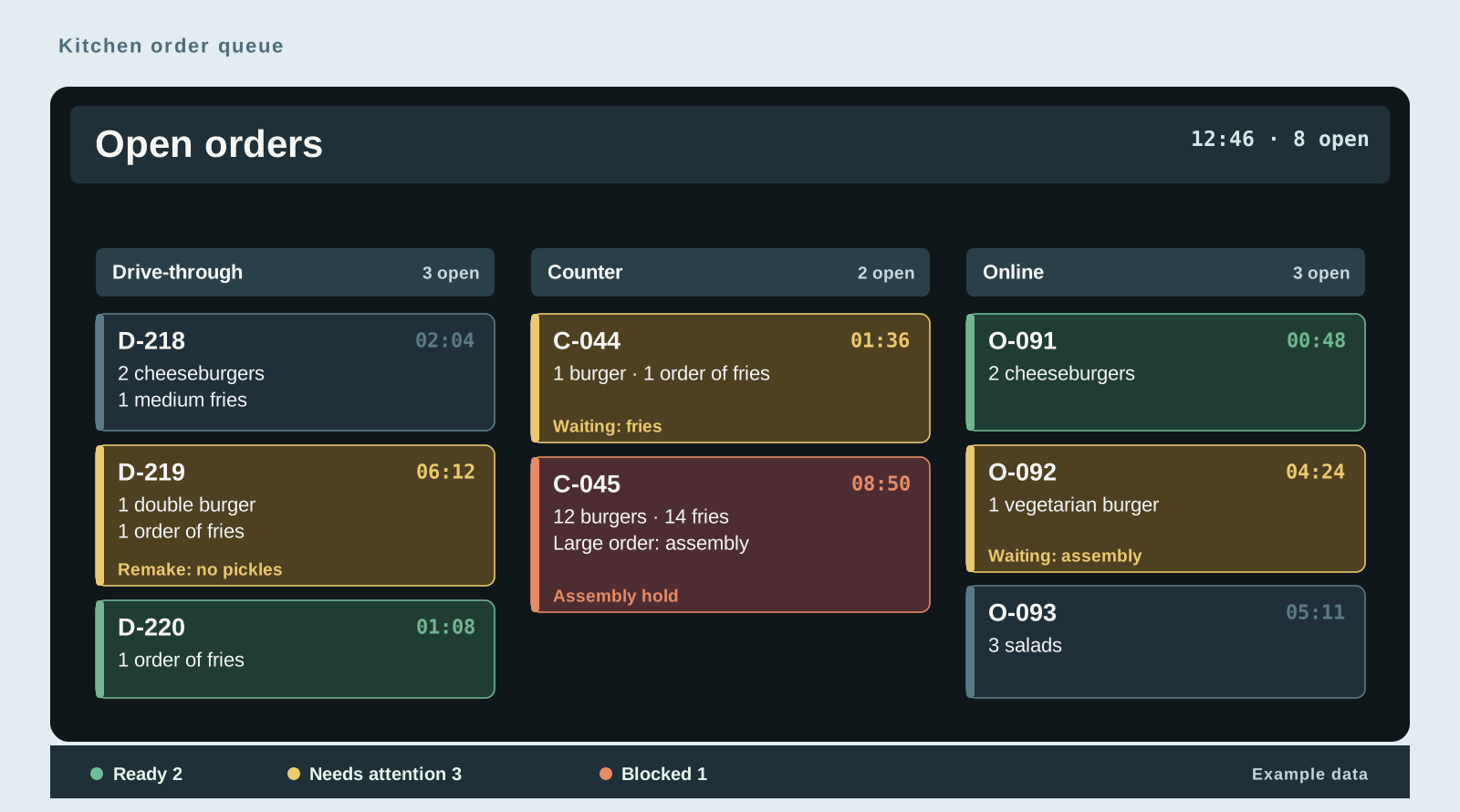
A kitchen display at McDonald's offers a useful way to think about the work. Orders arrive from the drive-through, the counter, and online. Each station sees what it needs to prepare. A large order can hold up other orders at a station, and an exception may require someone to remake an item. A permit office also has work moving between specialized reviewers, often with dependencies and repeat visits. To improve the process, managers need to see what is waiting at each step.
Portland measured first reviews but left out rechecks
Portland's 2021 audit found that the city used time to complete the first plan review as its main shared measure across seven bureaus. That report included permits approved the same day and excluded later correction reviews. More complex projects performed worse against the city's timeliness goals, even though the goals allowed more days for different kinds of work.
When a reviewer requested changes, the applicant returned revised plans and staff checked them again. The initial-review result said little about the time needed to finish those later rounds.
Portland subsequently began measuring rechecks and the time from application to issuance. Its 2025 permit dashboards distinguish time spent by city reviewers from time spent with applicants. They also report the time to approved to issue, when city review is complete but final payment or other issuance steps may remain.
A city needs to know whether its own reviewers are late, whether an applicant is preparing corrections, and whether review is complete but issuance is pending. Each interval points to a different kind of problem.
Median times can improve while difficult cases wait
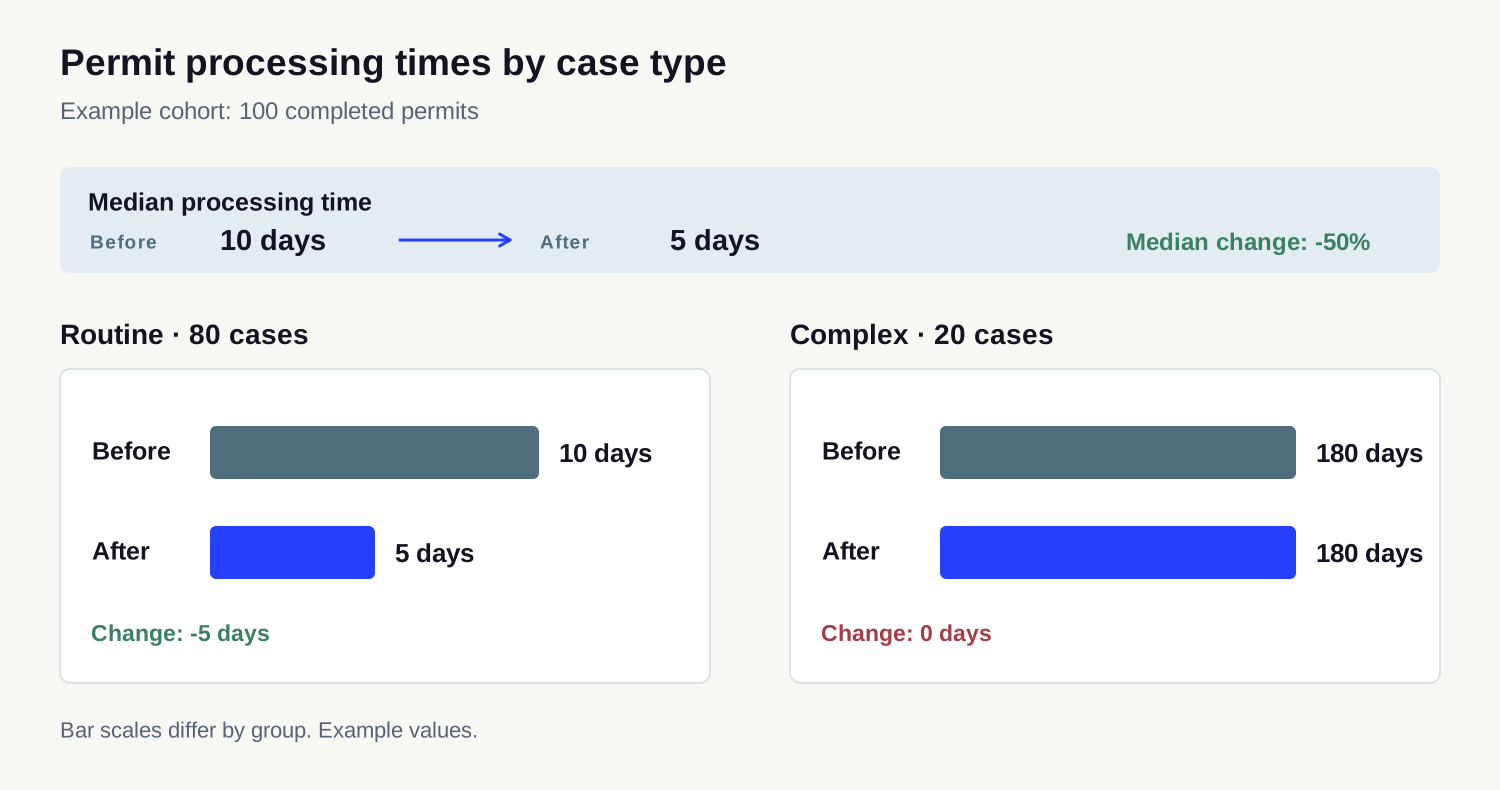
Consider 100 completed permits. Eighty routine applications take 10 days and 20 complex applications take 180 days. The city speeds up the routine work, bringing those 80 applications down to five days. The complex cases still take 180 days.
The median falls from 10 days to five. The improvement is substantial for routine applicants. It says nothing about progress on the other 20 cases.
Reporting only issued permits leaves another gap. King County's permitting reports state that its residential timing dashboard includes permits issued during the past 12 months and excludes canceled and incomplete applications. A case that is still pending can be absent from a report about how long permits take.
A stronger benchmark would follow all applications submitted during the same period. It would record approvals, denials, withdrawals, expirations, and applications still pending. Completed cases can have a final processing time. Open cases need a different measure: how long they have already waited and which step currently holds them.
Track case complexity separately from delays
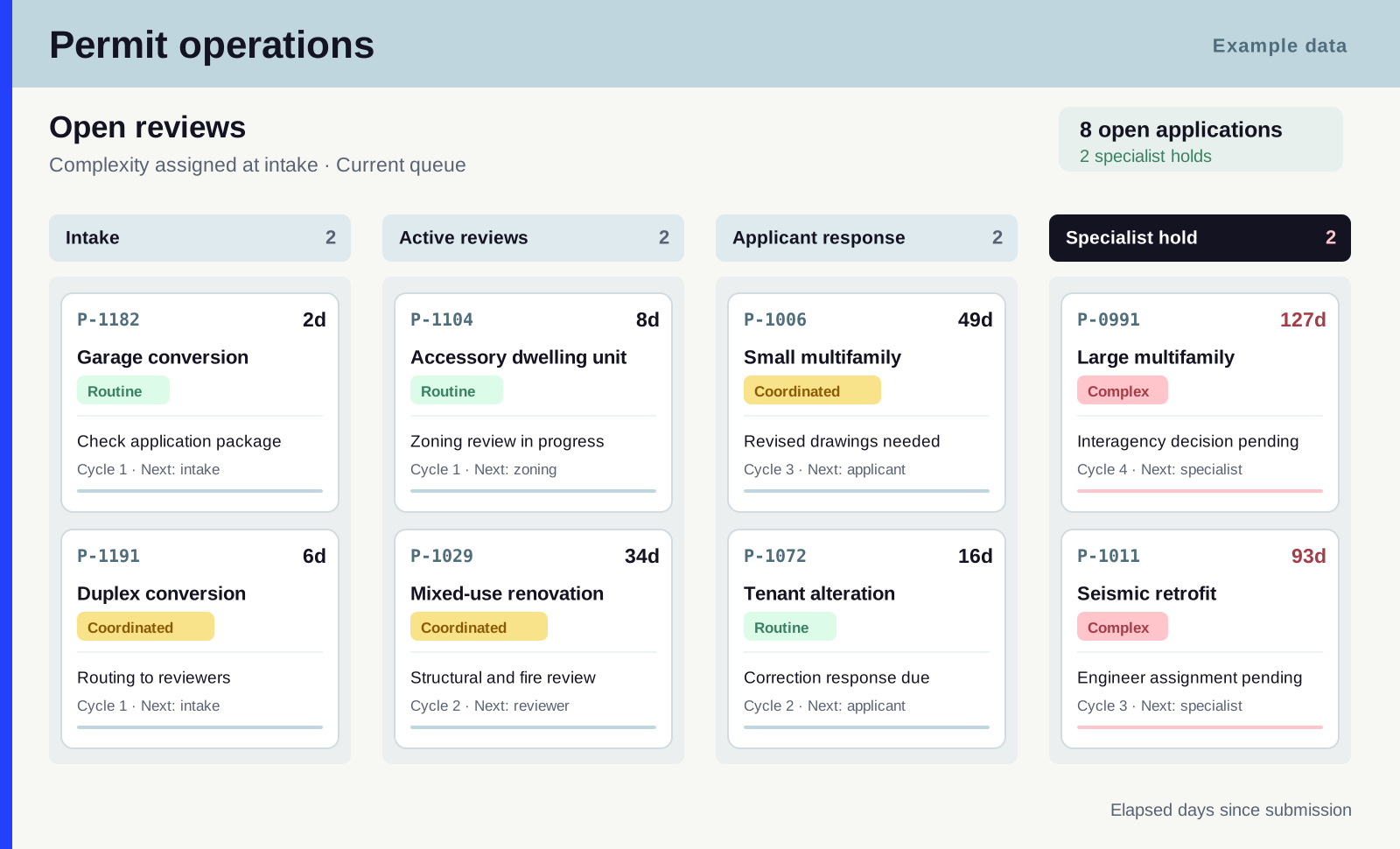
I would classify applications when they enter the system, using the expected work rather than how long they eventually take. A green case could be a routine permit with established requirements and limited review. A yellow case would need several reviews or coordination between departments. A red case would involve an exceptional technical or legal question that requires specialist judgment.
The criteria would need to be explicit and appropriate to each city's permit types. These categories describe the work involved. They make no prediction about whether an application complies with the building code or should be approved.
The city should separately record how each application is moving. Has a reviewer been assigned? Is work under way? Is the office waiting for corrected plans, or for another department to make a decision? Has a time target been missed?
A routine green case can become stalled. A complex red case can move through the required reviews on schedule. Recording the original classification, any later change, and the reason for that change would also stop a department from quietly redefining every delayed case as complicated.
A service blueprint would expose the handoffs
Service blueprints connect what an applicant experiences with the work staff carry out to deliver the service. The 18F method records user actions, visible interactions, backstage operations, and supporting processes. One of its published examples maps the service of ordering fast food.
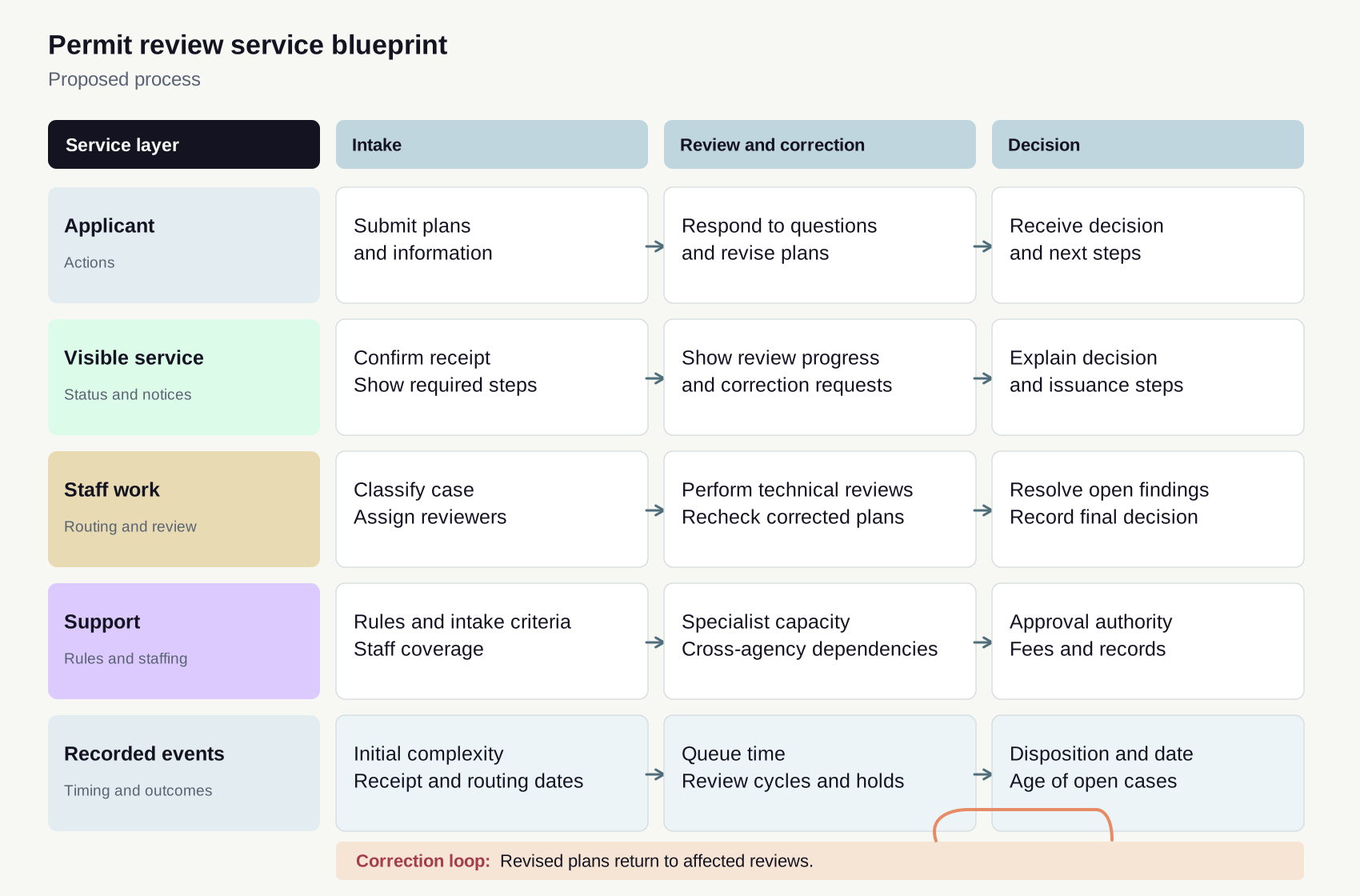
A permitting blueprint would connect each applicant step to the reviews and decisions behind it. It would also specify which events a department needs to record to explain delays.
| Layer | Intake | Review and correction | Decision |
|---|---|---|---|
| Applicant | Submits plans and required information. | Answers questions and submits corrected plans. | Receives a decision and any next steps. |
| Visible service | Confirms receipt and names the next step. | Shows active reviews and requests for corrections. | Explains the outcome and any remaining issuance steps. |
| Staff work | Classifies and routes the application. | Assigns reviewers, checks plans, coordinates decisions, and reviews corrections. | Resolves outstanding reviews and records approval or denial. |
| Supporting processes | Maintains rules, routing criteria, and reviewer capacity. | Manages specialist coverage and dependencies between departments. | Maintains decision authority, payment processing, and records. |
| Evidence to capture | Date received, complexity at intake, and date assigned. | Queue time, active review dates where available, correction cycles, and holds. | Decision date, outcome, total elapsed time, and unfinished cases. |
This table proposes the questions a blueprint should answer. It does not claim to describe the internal operations of Portland, Seattle, or any other city. Staff and applicants would have to map the actual steps and test the blueprint against real applications.
An application listed as "under review" for 30 days could be waiting for assignment, receiving active technical review, or held by a decision elsewhere. The status alone cannot distinguish those situations. A record of assignment, review activity, and handoffs could.
Seattle and Bellevue already measure parts of the process
Seattle's construction permit performance page reports targets by project type and includes measures of time under city and applicant control. Its permit timeline lets applicants inspect individual review cycles.
Seattle's Innovation and Performance team went further by examining how often applications needed another round of review. It identified drainage review as a recurring source of unsuccessful first submissions, worked with reviewers to improve guidance and procedures, and reported higher initial approval rates. The overall effect on time to final decision still needs to be measured separately.
Bellevue's permitting dashboards also distinguish first decisions from later review cycles. Bellevue publishes the median and 80th percentile by permit type, as well as average revision-cycle counts.
These dashboards could also report which applications remain open, how long they have waited, and which review stages are holding them up.
Benchmark each case type through final disposition
Cities could compare applications received during a given month, grouped by permit type and the complexity recorded at intake. Each group should show time to first substantive review, the number of correction cycles, and time to a final approval or denial. Withdrawn and expired applications belong in the same cohort report, with their outcomes identified separately.
For completed cases, publish the median and the 75th and 90th percentiles. For cases still pending, publish their current age and the share that has exceeded the relevant target. A case that has not reached a final decision cannot yet have a final processing duration.
Cities should also distinguish active review time from queue time when their records allow it. A date range labeled "with the city" does not establish that staff spent every day reviewing plans. If the available data cannot separate active work from waiting, that limitation belongs in the report.
Routine cases could use predictable routing and fewer duplicate checks. Coordinated cases could receive earlier attention to dependencies and consolidated correction notices. Exceptional cases could have a named coordinator responsible for identifying the outstanding decision, securing specialist review, and escalating a stalled issue. The goal for those difficult cases is a defensible decision, including a denial when the application cannot meet the requirements.
After a process change, the department could compare similar intake cohorts. Did the longest review times fall for yellow and red cases? Did applicants receive fewer repeat requests for the same correction? Did the number of red cases pending past their target decline? Faster routine approvals may free capacity, but that benefit should be demonstrated rather than assumed, especially when a separate specialist team handles the difficult reviews.
Applicants should see who has the next action
An applicant-facing tracker should reflect the same review history used by managers. It can show which reviews are complete, what remains open, the latest recorded action, and whether the applicant or the city needs to act next. An estimated decision date should appear only when the agency has a reliable basis for one.
For a permit still open after six months, the tracker should identify the outstanding review and the last recorded movement. The city's operating report should show the same case in its pending inventory, with its original complexity classification and the amount of time spent waiting at each recorded stage.
Sources
- Portland City Auditor, Building Permit Review Audit, March 2021
- Portland City Auditor, Audit Update: City advanced building permit reforms, June 2022
- Portland City Auditor, Development Services Bureau 2022 Audit Status Report, 2022
- Portland Permitting & Development, New dashboards provide enhanced insights into City of Portland's building permit processes, July 2025
- Seattle Department of Construction and Inspections, Construction Permit Performance, accessed October 2026
- Seattle Department of Construction and Inspections, Construction Permit Timeline, accessed October 2026
- Seattle Innovation and Performance, Modernizing Seattle's Permitting Process, accessed October 2026
- City of Bellevue, Permitting Dashboards, accessed October 2026
- King County Department of Local Services, Permitting reports, accessed October 2026
- 18F, Service blueprint, 18F Methods